San Antonio Can’t Talk Economic Growth Without Backing Small Business by Irene Chavez
If San Antonio is serious about economic growth, it must stop treating small businesses as a feel-good sidebar to development strategy. Small businesses are one of the city’s clearest engines of jobs, neighborhood stability, and local reinvestment. In fact, they make up 93.1% of establishments in the San Antonio–New Braunfels metro area and account for 21% of the county workforce—numbers that should settle any debate about whether this sector belongs at the center of policy decisions.
To the city’s credit, public agencies, nonprofits, and business groups are finally pushing harder on capital access, technical assistance, and collaboration. But progress will mean little if these efforts remain fragmented, episodic, or too dependent on rhetoric.
That is especially true in historically underserved neighborhoods, where entrepreneurs have too often been asked to survive on grit while being denied consistent access to lending, investment, and institutional support. Any serious small-business strategy must confront that imbalance directly.
The Business Development Organization Alliance (BDO), powered by LISC San Antonio, emerged from the Small Business Ecosystem Assessment, a 2020 report by NextStreet and Common Future supported by JPMorgan Chase. For years, San Antonio’s small-business ecosystem has faced a core challenge: too many organizations working in isolation, too little coordination, and too little urgency to match the need. Entrepreneurs should not have to navigate a patchwork of disconnected programs just to access support. The report highlighted major gaps in access to capital and business services for small business owners of color and proposed ways to address inequities exacerbated by COVID-19.
The BDO Alliance is an important test to see whether San Antonio can turn shared intent into coordinated action. San Antonio does not need another tidy statement of values nearly as much as it needs follow-through, accountability, and investment strong enough to match the city’s small-business rhetoric.
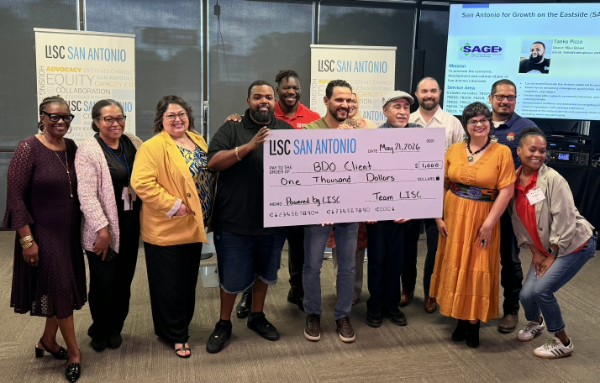
The strongest argument for backing small businesses is visible in the entrepreneurs already doing the work. This week, LISC San Antonio has recognized Small Business Month by providing recognition and a small $ 1,000 grant to several local entrepreneurs, demonstrating what local enterprise looks like when it serves needs the broader economy often ignores.
Take, for example, Xochitl Eufrasia Codina, owner of Xochitl Holistics. She represents the kind of entrepreneur institutions often overlook; locally rooted, culturally fluent, and responsive to forms of care that traditional systems have failed to provide.
Jacqueline Hernandez, owner of Revelations Counseling Center, has built a business around a need that many communities still struggle to meet: accessible, bilingual, culturally grounded mental health care. That makes her business more than a service provider; it is part of the city’s social infrastructure.
Mike Brown, owner of Tanks Pizza, represents one kind of neighborhood entrepreneur: a business owner whose work helps sustain the everyday life of a commercial corridor. Businesses like his do more than serve customers; they create familiarity, foot traffic, and a sense of local continuity. Barrio Barista, the Westside coffee shop and café co-owned by father-and-son team Gilbert De Hoyos Sr. and Gilbert De Hoyos Jr., offers a similar example. Rooted in family history and neighborhood identity, the business demonstrates how small enterprises can serve as gathering places that strengthen trust, preserve local character, and contribute to long-term economic stability.
Abdelbasset Ridene, owner of Royal Pizza, represents another pillar of San Antonio’s economy: the immigrant-owned business that endures not because conditions are easy, but because its owners are exceptionally resilient. His story shows that San Antonio’s small-business future will not be secured by praise alone. It will depend on whether the city matches its admiration for entrepreneurs with sustained, practical support.
With organizations like LISC San Antonio leading the way, the real question is no longer whether small businesses matter. It is whether San Antonio is prepared to organize its policy, capital, and civic will around that reality. If the BDO Alliance can align nonprofits, chambers, and partners around clear, measurable results, it would create ripple effects of prosperity for our community. Most importantly, it would also begin to narrow one of the city’s most persistent economic divides.